Every tiktok creator brief is a record of what a brand actually believes, as opposed to what it says it believes, and a 2026 survey of more than 250 marketing leaders captured the distance between the two with unusual precision. 93% of marketers agree that campaigns perform best when creators use their own voice. 7% give creators full creative freedom. That is not a rounding difference or a matter of degree. It is a near-universal stated conviction paired with near-universal contrary practice, and the brief is the document where the contradiction gets written down. The same research found that 66% of marketers already work with creators and another 10% intend to start this year, that 50% expect creators to be a core or secondary channel, and that brand awareness dominates the stated use case at 82% while direct sales trails at 29%. Most usefully, the marketers who reported success with creator campaigns were 1.7 times more likely to let creators ideate and produce the content. The brief is where that multiplier is either granted or quietly withheld.
Table of Contents
Why the Creative Freedom Gap Drives TikTok Creator Brief Design
The typical brief is written defensively, and the reasons are legitimate in isolation. Legal needs disclosure language. Regulatory affairs needs claim substantiation. Brand needs the logo treated correctly and competitors unmentioned. Each requirement is individually reasonable. Assembled into a single document, they produce a fifteen-page instrument in which a creator cannot distinguish a federal requirement from a stylistic preference, and so treats every line as mandatory. The content that results is what the brand asked for and not what the brand wanted.
Marketing Brew’s survey of marketing leaders quantifies the cost of that confusion. When 93 percent of marketers believe creator voice drives performance and 7 percent actually permit it, roughly nine in ten programs are being run against their own operators’ stated theory of what works. This is not ignorance. Marketers know the answer. The gap survives because brand protection is a reflex exercised by people with veto authority, while creative latitude is an argument made by people without it, and the brief is where veto authority is exercised line by line.
The performance correlation in that data is the part worth acting on. Marketers who reported successful creator campaigns were 1.7 times more likely to have let creators ideate and create the content themselves. Correlation is not proof of direction, and it is possible that success made those brands relaxed rather than relaxation making them successful. But the mechanism is not mysterious. Platform distribution rewards content that holds attention, and audiences withdraw attention from content that sounds like it was approved. A brief that scripts the hook, mandates the phrasing, and dictates when the product appears produces exactly the signals the algorithm reads as commercial, which suppresses the reach the brand paid for.
The objective data explains why so many briefs are miscalibrated in the first place. Awareness is named as the top creator use case by 82 percent of marketers while direct sales sits at 29 percent, yet briefs are routinely written with the caution appropriate to a direct-response ad. A brand pursuing awareness has very little to lose from a creator’s unexpected framing and a great deal to lose from content nobody watches. The risk calculus that justifies a tightly scripted brief belongs to a conversion asset, and most creator content is not one. Brands import the control posture from a job the content is not doing.
The right structure follows from this. A brief should be organized so that non-negotiables are unmistakably separated from preferences, and preferences are honestly labeled as such rather than smuggled in alongside compliance language. Disclosure requirements, claim substantiation, competitor exclusions, and commerce mechanics are fixed and should be stated with precision and with the reason attached, since a creator who understands why a requirement exists complies with it more reliably than one who suspects it is bureaucratic. Everything else, meaning hook, structure, pacing, tone, humor, and the moment the product enters the story, is the creator’s to determine. Two-thirds of marketers already work with creators. Almost none of them are getting what they believe they are buying, and the document is the reason.
What Enterprise Brands Should Expect From a Creator Briefing Partner
Program strategy and design. The agency has to establish the objective before the brief is drafted, because the amount of creative control a brand should retain is a function of what the content must accomplish. An awareness asset and a conversion asset warrant different constraints, and conflating them is what produces the over-specified brief. This determination belongs inside dedicated campaign services at the outset.
Creator sourcing and verification. The agency has to select creators whose judgment the brand can afford to trust, since creative latitude granted to a poorly chosen creator is a risk rather than a lever. Verification therefore covers not only audience quality and performance history but a creator’s demonstrated handling of branded work, their disclosure discipline, and whether their previous partnerships read as native or as delivered.
Platform and commerce integration. The agency has to specify commerce mechanics as narrative function rather than as timestamps, because a promo code demanded at the thirty-second mark reads as an ad while the same code introduced when the story calls for it does not. The mechanics themselves belong in the fixed layer, and brands can see how they connect to the wider channel in the firm’s TikTok influencer marketing resource.
Creative direction and content production. The agency has to write briefs that vary by creator rather than distributing one document to a roster, since identical direction produces near-identical content and audiences encountering the same branded post five times discount all five. A UGC overview explains the production logic that makes varied output practical at scale.
Audience and segment-specific execution. The agency has to tell each creator which audience they are responsible for and what that audience needs to come away believing, and then stop. That is direction. Instructing the creator how to open the video, which words to use, and where to place the product is not direction, it is drafting, and it substitutes a marketer’s instinct about an audience for the instinct of the person who has spent years earning that audience’s attention. The brief should convey the destination and leave the route alone.
Cross-platform orchestration. The agency has to establish usage rights and amplification permissions inside the brief itself, because the most common failure in creator programs is a piece of content that performs and cannot be used. Rights, territories, duration, and permitted objectives belong in the fixed layer alongside disclosure, and settling them at briefing rather than after the fact is what allows a brand to move budget behind a winner rather than negotiate for the privilege while the moment passes.
Paid amplification. The agency has to tell the creator, in the brief, what performance threshold will trigger additional spend and what that means for their content, since creators who know a post can be amplified produce differently than creators who assume the work ends at publication. Those thresholds are managed through a specialties and services capability built to act on live signal.
Attribution and measurement. The agency has to define in the brief what will be measured and share the results back, because creators who never see performance data cannot improve against it. Closing that loop requires an analytics capability that treats creators as partners in optimization rather than as vendors.
Program Delivery Across Briefed Creator Campaigns
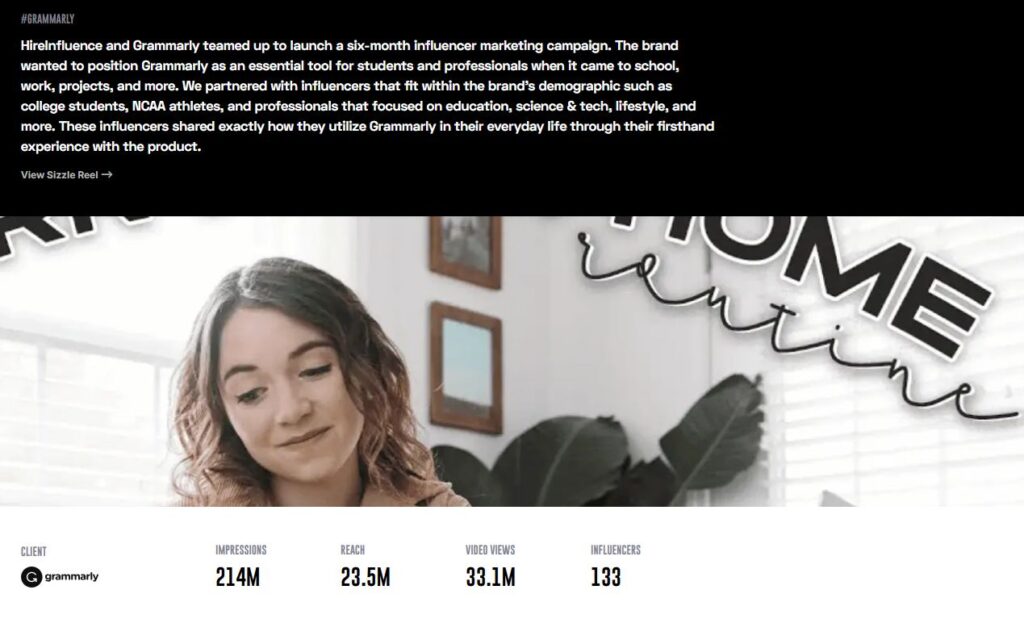
Briefing discipline is visible in outcomes. The #OREOShamROCKout activation for Oreo and McDonald’s delivered 1.7M impressions at $0.06 cost per engagement, an efficiency figure that reflects creative audiences chose to engage with rather than scroll past. The #CoatYourThroat program for Ricola reached 20.5M people across 26M impressions with 18 influencers, sustained a 13.17% engagement rate, and drove 62,500 MikMak retail clicks, documented in the Ricola case study. Sustaining an engagement rate above 13 percent across a full roster is not something a script produces. The Grammarly creator program coordinated 133 creators to generate 214M impressions and 33.1M views with $15M in earned media value, which is a briefing problem before it is a media problem, since 133 near-identical videos would have earned a fraction of that reach.
The #MyMTVStyle campaign for MTV produced 16.1M impressions and 216,600 engagements at $0.01 cost per view and a $1.50 CPM on TikTok, and the #SouthwestSaysAloha program for Southwest Airlines reached 56M impressions and 3M engagements. Additional programs are collected in the work portfolio.
How to Evaluate a TikTok Creator Brief Agency
First, ask to see a brief the agency has actually used. The agency should be able to show the separation between fixed requirements and creative latitude on the page, and if compliance language and stylistic preference appear in the same bulleted list, the document is producing scripted content regardless of what the agency says about creative freedom.
Second, ask what the agency has removed from a brief recently and why. The agency should distinguish between requirements that are legally or commercially mandatory and requirements that are institutional habit, and it should have a practice of retiring the second category.
Third, ask how briefs differ across a roster. The agency should describe per-creator direction that references each creator’s own strongest work, because a single brief distributed to twenty people yields twenty versions of the same video and forfeits the variety that sustains distribution.
Fourth, ask what the approval process looks like and how long it takes. The agency should defend a short review window scoped to compliance and brand safety only, since a lengthy multi-stakeholder approval trains creators to submit safe work that will not attract revisions and will not attract audiences either.
Fifth, ask how briefing decisions affect cost. The agency should explain how content volume, usage rights, revision rounds, and creator ideation time appear as separate lines, reasoning from a published cost of influencer marketing guide rather than presenting briefing as a free input.
The HireInfluence Model for TikTok Creator Briefs
Founded in 2011, HireInfluence is a full-service enterprise influencer marketing agency with 25+ people across 10+ states, working from four offices: Houston and The Woodlands in Texas, Austin, Los Angeles, and New York. The firm has run programs for Meta, Coca-Cola, Walmart, MTV, Ricola, and Microsoft on a six-figure engagement floor, which reflects the strategy, rights, and production work that precedes any brief it writes.
HireInfluence has been a TikTok Shop Lite Program partner since July 2024, which shapes how commerce mechanics enter a brief, since a purchase path specified as a narrative moment performs differently from one specified as a timestamp. The agency was named Marketing Agency of the Year at the 2024 MUSE Creative Awards and Digital Marketing Agency of the Year at the 2026 U.S. Agency Awards.
Before founding the firm in 2011, Jason Pampell spent years managing content rights, licensing, and strategic media partnerships for Forbes and Billboard, where every agreement had to state precisely what was fixed and precisely what was left to the people making the work. A brief is that same instrument. It is not a script and it is not a wish, it is a set of terms that defines the boundary of the permissible and then declines to legislate inside it. The HireInfluence team writes briefs on that principle, which is why its documents tend to be shorter than a brand expects and more specific about the few things that genuinely cannot move. Brands can reach the firm through its contact page or read more about its background in the about section.
The survey data leaves little ambiguity about where the opportunity sits. When nearly every marketer believes creator voice drives performance and almost none permit it, the constraint on creator marketing is not talent, budget, or measurement. It is a document, and rewriting it costs nothing.