
A large-scale influencer campaign is not simply a small campaign with more creators added to the roster. It is a fundamentally different operational undertaking. The complexity does not scale linearly with creator count — it multiplies. Brief coordination that is manageable for five creators becomes an operational system requirement at 50. FTC compliance review that one person can handle for a handful of posts requires a documented workflow at enterprise volume. Performance tracking that works in a spreadsheet for 10 creators demands proper attribution infrastructure at 100.
Table of Contents
The brands that run large-scale influencer campaigns effectively are not the ones with the largest budgets. They are the ones with the right operational infrastructure behind those budgets. According to Archive.com’s influencer marketing ROI metrics research for 2026, 75% of brands have now implemented direct sales tracking — a meaningful sign of measurement maturity. But only brands with the operational systems to run campaigns at volume can actually generate the data those tracking systems need to produce meaningful attribution, because volume without infrastructure produces chaos rather than insight.
What Defines a Large-Scale Influencer Campaign
Scale in influencer marketing is measured across multiple dimensions simultaneously: the number of creators active at once, the number of platforms being managed, the volume of content pieces in review and publication across a single campaign window, and the complexity of the measurement and reporting requirements attached to the program.
A program with 30 creators posting across TikTok, Instagram, and YouTube in a single two-week window is generating approximately 90 or more individual content pieces, each requiring brief delivery, creative review, FTC disclosure verification, scheduling coordination, and post-publication monitoring. A program with 100 creators is generating 300 or more. The operational requirements of that volume — without errors, without compliance gaps, without creator communication failures that result in missed deadlines or off-brief content — are significant enough that they represent the primary determinant of whether a large-scale campaign performs or underperforms.
The content review function alone illustrates the operational challenge. Every piece of creator content must be reviewed against brand guidelines before publication. FTC disclosure language must be verified. Claims made about the product must be within approved guardrails. For a program running 50 creators posting across a single week, that is 150 or more reviews to complete in sequence, with enough lead time before each creator’s scheduled publication date to allow for revisions. Without a systematic review process and documented approval workflow, this function becomes a bottleneck that either delays the entire campaign or gets cut short in ways that create compliance exposure.
Why Most Agencies Cannot Deliver at True Scale
The influencer marketing industry has grown to include nearly 7,000 specialized agencies and platforms globally. Most of those serve brands running programs at modest scale — five to fifteen creators per campaign, one or two platforms, with internal brand teams handling portions of the workflow. The infrastructure required to manage large-scale campaigns professionally — creator relationship management systems, content workflow tools, systematic compliance review, cross-platform performance tracking, paid amplification integration, and full financial administration including 1099 processing — is expensive to build and requires years of large campaign experience to refine.
The agencies that genuinely operate at large-scale campaign volume have client histories that reflect that experience. They can point to specific programs with specific creator counts across specific platforms and explain exactly how the operational workflow handled the volume. Agencies that cannot provide that specificity are scaling up their normal process and hoping it holds — which it often does not.
HireInfluence’s Large-Scale Campaign Infrastructure
HireInfluence has been executing large-scale influencer campaigns since 2011. The agency’s back-end operational systems are built for volume: creator relationship management that tracks communication, deliverables, and performance across large rosters simultaneously; brief and content workflow systems that manage review queues at scale; FTC compliance verification that documents sign-off on every piece of content before publication; and influencer payment and 1099 processing for large creator rosters without administrative gaps.
The campaign services architecture covers every function the volume requires. Creator sourcing and vetting at scale means running a systematic evaluation process across a large candidate pool — audience authenticity checks, engagement quality analysis, content history review, brand safety assessment — rather than selecting from a pre-approved shortlist. For large-scale programs where the creator mix spans micro through macro tiers, that vetting process is running simultaneously across creator profiles at different tiers and with different content styles.
Paid amplification is a native capability in HireInfluence’s large-scale program structure, not an add-on. The highest-performing organic content from a large-scale campaign is the brand’s most valuable paid creative asset. Identifying those pieces quickly, securing amplification rights that were already negotiated in the initial creator contract, and deploying paid distribution efficiently through whitelisting and dark posting is what converts large-scale campaign investment into compounding return. The analytics infrastructure consolidates performance data from all platforms and creator tiers into unified reporting that connects campaign volume to business outcomes.
HireInfluence’s exclusive TikTok campaign capabilities, through its official TikTok Shop Lite Program partnership secured in July 2024, provide direct platform data and premium ad access for large-scale programs where TikTok is a primary or significant platform. That infrastructure advantage is especially relevant for brands running large creator rosters on the platform that commands the highest investment intent among enterprise marketers in 2026.
What Large-Scale Campaigns Actually Produce
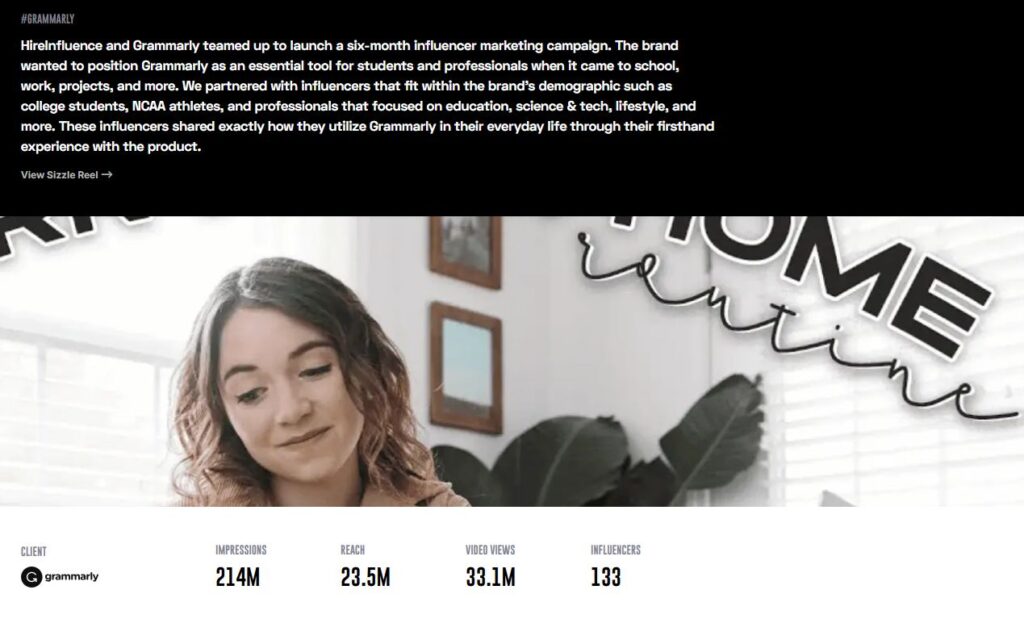
The Grammarly program is the reference case for large-scale campaign execution at HireInfluence. The agency managed 133 top-tier lifestyle creators across YouTube, TikTok, and Instagram simultaneously — brief delivery and content review for every creator, FTC compliance across three platforms, scheduling coordination for a sustained campaign window, and real-time performance monitoring across all channels. The output: 214 million impressions, 33.1 million views, and $15 million in earned media value. That program required every component of the large-scale campaign infrastructure to be functioning correctly at the same time.
The Ricola #CoatYourThroat campaign demonstrates attribution at scale. Eighteen creators across micro to celebrity tier, with MikMak retail purchase link tracking set up across every deliverable before any creator posted, produced 26 million impressions, a 13.17% engagement rate, and 62,500 tracked retail purchase clicks. The precision of that attribution is not achievable without the pre-launch infrastructure setup that large-scale campaign management requires.
The Southwest Airlines #SouthwestSaysAloha campaign generated 56 million impressions and 3 million engagements. The MTV #MyMTVStyle TikTok campaign delivered 16.1 million impressions at $0.01 cost per view. These outcomes reflect what large-scale programs produce when the creator selection, content direction, platform strategy, and operational execution are all working correctly together. Each of these creator-driven programs represents the operational output of a full-service agency working at enterprise volume.
Evaluating an Agency for Large-Scale Campaign Execution
Enterprise brands evaluating agency partners for large-scale influencer campaigns should ask operational questions that reveal whether the agency has genuinely built the infrastructure or is planning to scale up its standard process.
What is the content review workflow for a program with 50 creators posting across a single week? How many reviews are completed simultaneously, who approves them, and what is the documented escalation process when a creator’s content requires revision? The answer to this question reveals whether the agency has an actual system or is improvising.
How are FTC disclosures verified at volume? A briefing call that tells creators to add disclosure language is not a compliance system. A documented review process with sign-off before each post goes live is. At large-scale campaign volume, the difference between those two approaches is significant from a legal and reputational risk standpoint.
How is creator performance tracked in real time across a large roster? What does the reporting cadence look like during the campaign, and what triggers a mid-campaign adjustment when a creator or content type is underperforming?
HireInfluence’s minimum engagement is approximately $100,000, which reflects the full operational scope of what large-scale campaign management at enterprise standards requires. For brands ready to run creator programs at volume with the infrastructure those programs demand, connect at hireinfluence.com/contact/, review the campaign portfolio, and learn about the agency’s history at hireinfluence.com/about/.