
The way enterprise brands evaluate an influencer marketing company has changed. Two years ago, the conversation centered on creator networks and campaign execution. Today, the conversation is about attribution. That shift is visible in how the measurement industry itself has restructured to meet enterprise demand. In July 2025, Nielsen, headquartered in New York, launched its Outcomes Marketplace, an interoperable ecosystem bringing brand, sales, attention, and conversion metrics together within the Nielsen ONE platform for the first time. The launch confirmed what enterprise marketers had been signaling for years: reach and frequency alone are no longer sufficient to justify creator investment at scale, and the measurement standards that apply to other paid media channels now apply to influencer marketing too.
Table of Contents
For New York-based enterprise brands evaluating an influencer marketing company, that shift raises the bar for what a credible partner has to deliver. An NY enterprise marketing team cannot defend creator spend to a CFO using impression and engagement metrics alone. The partner has to provide attention, attribution, and conversion measurement that compares directly to CTV, paid search, and other major media channels. This guide breaks down what New York enterprise brands should expect from an influencer marketing company in 2026, how to evaluate capability at the level the NY market now requires, and what separates a credible full-service partner from a surface-level offering.
Why the Measurement Shift Changes the NY Buying Decision
The Nielsen Outcomes Marketplace launch matters because it signals where the entire creator economy is heading. When Nielsen builds infrastructure for creator attribution alongside its traditional TV and digital measurement capabilities, the industry responds by expecting that standard everywhere. Captiv8, the influencer marketing platform cited in the Nielsen announcement, adopted the attention measurement solution to track effectiveness across creator campaigns. That adoption pattern is rippling through enterprise buying decisions.
For New York enterprise brands, the implications are direct. A brand running a creator program through an influencer marketing company now has to ask specific questions about measurement methodology. Can the partner integrate with industry-standard attention measurement tools? Does the attribution framework capture brand perception shifts, sales conversions, and audience engagement as separate measurable outcomes? Is reporting delivered in a format that can be compared against other paid media investments? An influencer marketing company that cannot answer those questions in detail is not built for NY enterprise standards.
The same Nielsen announcement noted that advertisers are demanding metrics like ad engagement, audience attention, brand perception shifts, and sales conversions as part of a comprehensive view of campaign outcomes. That is the measurement profile an NY enterprise brand needs its influencer marketing company to deliver. It is also the profile that separates companies built for enterprise engagements from those optimized for smaller-scale or experimental programs.
What a Full-Service NY Influencer Marketing Company Should Include
A credible enterprise-grade influencer marketing company in New York operates across eight service functions that work as a coordinated system rather than as sequential handoffs.
Program strategy and measurement design. The engagement starts with business objectives, KPI frameworks, creator tier mix, platform strategy, and attribution methodology defined up front. For NY enterprise brands, strategy also accounts for the media calendar that matters in the most competitive attention market in the country: fashion weeks, entertainment launches, retail tentpoles, and the platform product cycles that determine when creator campaigns have the highest impact. HireInfluence structures strategy as the opening phase of every engagement through its campaign services capability.
Creator sourcing and vetting. The NY market has more creators than any other US city, which means the sourcing challenge is not scarcity but selection. A credible influencer marketing company runs tier-matched sourcing (nano through celebrity), audience authenticity analysis, brand safety vetting, and category conflict screening as standard steps before creators are presented for campaign consideration.
Creative direction and content production. NY content quality expectations are higher than in almost any other US market. A full-service partner runs creative development in coordination with creators, including on-set production support when programs call for higher-production content. The NY creator-adjacent production infrastructure (studios, post houses, and lighting crews) is accessible to partners with local relationships and operational depth.
Contracting and rights management. Enterprise legal review, usage rights structuring, exclusivity windows, approval workflows, and FTC-compliant disclosure language. Rights structure has to be negotiated at the contract stage so content can be repurposed across paid social, CTV, retail media, email, and owned channels downstream.
Paid media amplification. Organic creator content is the starting point, not the endpoint. A full-service influencer marketing company runs paid amplification as an integrated service across Meta, TikTok, YouTube, and emerging platforms. HireInfluence covers this through its specialties and services capability, which includes whitelisting, dark posting, and multi-platform amplification.
Attribution infrastructure. UTM frameworks, promo code systems, pixel tracking, conversion event integration, and integration with industry-standard measurement partners. This is the capability that Nielsen’s Outcomes Marketplace launch flagged as the new enterprise baseline. HireInfluence’s analytics capability is designed to give NY enterprise clients the measurement detail that the current market now expects.
In-flight optimization. Always-on programs require budget reallocation across creators and platforms based on performance, creative adjustments mid-campaign, and the identification of emerging creators who should be added to active programs.
Executive reporting. Deliverables that translate creator activity into business outcomes (cost-per-acquisition, revenue attribution, measurable lift) for C-suite stakeholders evaluating creator investment against other major media channels.
New York Campaign Execution at Enterprise Scale
NY enterprise brands evaluating an influencer marketing company should look at campaigns that demonstrate what full-service delivery actually produces at the scale the NY market requires.
The imPress Nails campaign activated during New York Fashion Week is a useful example of what NY-specific enterprise execution looks like. The program partnered with luxury fashion influencers whose audiences and personal brand positioning matched the imPress brand, launched in direct alignment with one of the most aesthetically rigorous moments in the fashion calendar, and structured content with direct-to-website CTAs that converted NYFW attention into measurable purchase activity. That is not a generic influencer activation. It is a services engagement calibrated to NY-specific conditions, with creator selection and attribution infrastructure both working against the same campaign objective.
The Ricola #CoatYourThroat program demonstrates a different dimension of enterprise-scale delivery. The campaign drove 26 million impressions, 20.5 million reach, a 13.17% engagement rate across 18 influencers spanning micro to celebrity tier, and 62,500 MikMak retail purchase clicks. The retail attribution integration is the specific capability that Nielsen’s Outcomes Marketplace launch called out as the new enterprise measurement baseline. A review of the Ricola case study shows how the operational layers come together in a single program architecture.
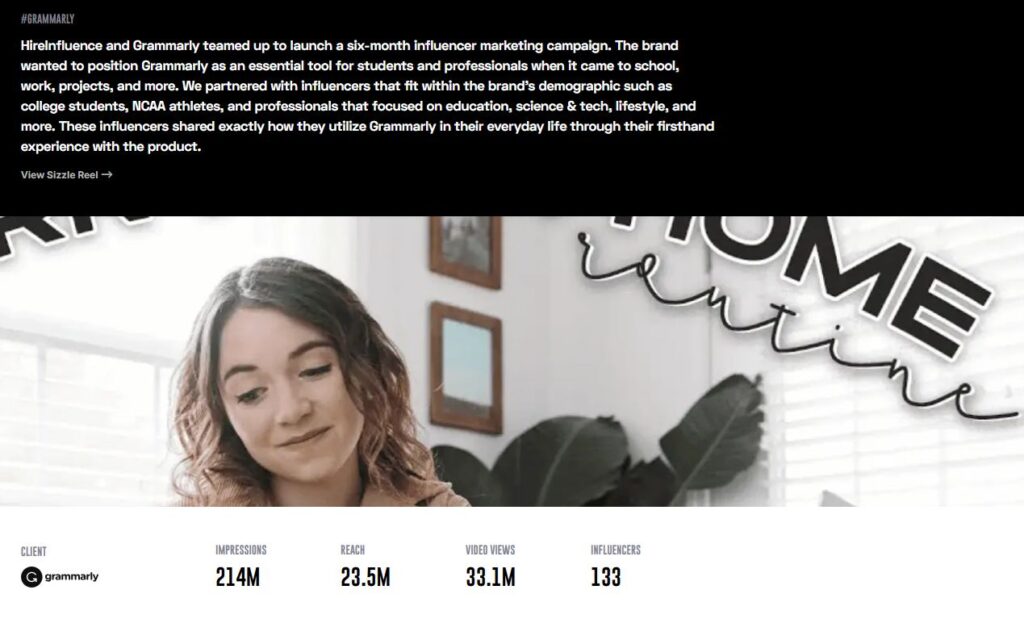
The Grammarly engagement activated 133 creators across YouTube, TikTok, and Instagram, producing 214 million impressions, 33.1 million views, and $15 million in earned media value. A 133-creator program at that scale cannot be run through a distributed vendor model. It requires the full service stack operating in coordination. For NY enterprise technology and productivity brands, the Grammarly numbers set a benchmark for what a full-service engagement should produce.
The MTV #MyMTVStyle TikTok campaign delivered 16.1 million impressions at $0.01 CPV and $1.50 CPM with 216,600 engagements. For NY-based entertainment, media, and consumer brands, those efficiency figures are the benchmark that enterprise finance teams use to compare creator spend against other paid channels.
How NY Enterprise Brands Should Evaluate a Partner
Five questions separate a credible enterprise-grade influencer marketing company from surface-level offerings for New York buyers.
First, ask about attribution methodology in specific detail. The partner should describe UTM infrastructure, promo code systems, pixel tracking, conversion event integration, and how the reporting ties to the measurement partners (including Nielsen) that enterprise finance teams recognize as industry standard. Generic answers about measurement capability are not answers.
Second, ask about integrated paid amplification. Creator content that produces impressions organically but cannot scale through paid media is not enterprise-ready. The partner should describe specific amplification capabilities across Meta, TikTok, YouTube, and emerging platforms as a core service.
Third, ask about the NY creator network. In a market with this much creator depth, direct relationships often determine whether the right creators are available at the right windows. A partner with deep NY relationships will describe specific creator tiers and categories where those relationships are strongest.
Fourth, ask about enterprise delivery capacity. Staffed program teams, dedicated account leadership, and separate roles for strategy, sourcing, creative, contracts, paid media, and reporting. The enterprise standard has moved past single-point coordination across contractors.
Fifth, ask for enterprise references with specific campaign outcomes. NY marketing leadership talks to other NY marketing leadership. A partner with genuine enterprise depth will have those references available on request.
The NY-Anchored Influencer Marketing Company Model
HireInfluence maintains a New York office alongside offices in Houston and The Woodlands, TX; Austin, TX; and Los Angeles, CA. The agency was founded in 2011 and is recognized as one of the first full-service influencer marketing companies in the United States. Fifteen years of operation in New York has built the creator relationships, production infrastructure access, and enterprise client depth that distinguish a credible NY partner from a newer entrant.
Engagements typically start at approximately $100,000, which aligns with the enterprise delivery standard. The client roster includes Microsoft, Southwest Airlines, Target, Coca-Cola, Walmart, Meta, McDonald’s, Oreo, Grammarly, Ricola, and MTV. Award recognition across 2024 and 2026 includes the MUSE Creative Awards, Netty Awards, NYX Awards, Global Digital Excellence Awards, U.S. Agency Awards, and Vega Digital Awards. The agency is also an exclusive TikTok Shop Lite Program partner since July 2024, providing direct access to TikTok’s social commerce infrastructure for programs that require conversion-measurable delivery.
Jason Pampell, Founder and CEO, launched HireInfluence in 2011. Prior to founding the company, he managed content rights and strategic media partnerships for Forbes and Billboard and brings 30+ years of leadership experience in sales, marketing, and team building for Fortune 1000 organizations. His approach to building the agency shaped the service model that NY enterprise brands engage with today.
For NY enterprise brands ready to evaluate what a full-service engagement should look like, the HireInfluence team handles initial conversations directly. Brands benchmarking pricing should reference the cost of influencer marketing guide for context on enterprise-scale engagement costs. Those evaluating TikTok-focused structures should review the TikTok influencer marketing resource. Brands integrating creator content with broader UGC strategy should review the UGC guide, and marketing teams looking at how full-service creator programs are executed across the agency’s portfolio should review the work portfolio.
The measurement shift that Nielsen’s Outcomes Marketplace launch confirmed is reshaping how NY enterprise brands evaluate an influencer marketing company. Attribution, attention, and conversion measurement are now the baseline. Creator selection, content quality, and paid amplification all matter, but they only matter when they connect to the business outcomes that enterprise finance teams can verify against other media channels. The influencer marketing company decision in New York is the decision about which partner can deliver at that measurement standard. Everything else follows from that.