A general agency can, if it can name what changed on TikTok during 2026. TikTok is the platform where the expensive mistakes are irreversible: authorisation expires terminally, captions lock permanently, and the creator marketplace moved inside TikTok One while the Shop marketplace was deprecated separately.
Table of Contents
- What cannot be undone
- The three 2026 changes, and why they make a fast diagnostic
- Disclosure mechanics that are specific to TikTok
- The ad products a general agency may not have run
- What to ask before appointing anyone to TikTok work
- Why TikTok-native creative is no longer the differentiator
- What should disqualify an agency, including this one
- Program Delivery Across TikTok and Cross-Platform Programs
- The HireInfluence Model for TikTok Programs
Choosing the best TikTok influencer agency is less about TikTok-native creative than brands expect, because creative fluency on TikTok is now widespread. The distinguishing capability is knowing which decisions cannot be undone, and keeping the calendar that prevents the ones that expire. TikTok is unusual among the major platforms in how much of its machinery is one-way, and an agency that treats it like Instagram will make a recoverable-looking mistake that turns out not to be recoverable. The broader question of whether to appoint platform specialists at all is covered separately in the guidance on running one agency across several platforms.
What cannot be undone
Four mechanics on TikTok are irreversible or effectively so, and each converts a casual decision into a permanent one.
Authorisation expiry is terminal. Spark Ads authorisation runs for 7, 30, 60, or 365 days. An expired code cannot be reactivated and a new one must be generated, which means going back to a creator who has to be reachable, willing, and still working with the brand. Extension is possible only before expiry, and only through the creator’s own account settings.
The caption locks permanently at authorisation. No edits afterwards, at all. A typo, an outdated offer, or a legal correction discovered after authorisation cannot be fixed on that asset.
Private videos become public during a campaign and cannot be reverted while it is running.
A video code cannot be deleted until every ad using it has been deleted first.
TikTok also publishes the error codes that follow when this is mishandled, including 4025 for an expired authorisation, 900010 for an ad scheduled past the authorisation window, and 4013 for copy-and-paste damage to a code, usually stray whitespace. The existence of a documented error taxonomy is itself informative: these are common enough failures that the platform catalogued them.
The three 2026 changes, and why they make a fast diagnostic
TikTok restructured meaningfully during 2026, and an agency’s awareness of the changes is the quickest available test of whether it is reading primary documentation or working from a deck written last year.
Creator Marketplace is now a module inside TikTok One, the unified marketer hub announced in May 2024, rather than a standalone product. Past campaigns and functionality carried into the upgraded account, and creators reach it through TikTok Studio, which redirects to TikTok One. An agency still describing TTCM as a separate destination is describing a product state that no longer exists.
The Shop marketplace is being deprecated separately. From June 2026 TikTok began notifying merchants in the United States that the external Creator Marketplace for TikTok Shop campaigns is being retired, with Shop creator collaboration moving to Seller Center and Shop Affiliate tools. This is a carve-out rather than a wholesale shutdown, and conflating the two is a common error.
Custom Identity is being retired in early 2026, with new campaigns required to launch from a verified TikTok profile. Brands with existing identities should ask directly how the transition affects them.
Disclosure mechanics that are specific to TikTok
Two things here are frequently got wrong, and both are one-way.
The label names are not interchangeable. Selecting Branded Content, meaning promotion of a third party, produces the Paid partnership label. Selecting Your Brand, meaning a business promoting its own products, produces a Promotional content label. These are different labels for different situations.
Once a disclosure label is added, TikTok does not allow it to be changed. Selecting the wrong one is not correctable on that post.
The performance argument for disclosure is settled by TikTok’s own research. The platform ran an internal study comparing nearly two million videos with and without proper branded content disclosure and found no performance difference, and states that the disclosure setting does not affect how content is recommended. The penalty runs the other way: commercial content that is not properly disclosed may not be eligible for distribution in the For You feed. Compensation includes in-kind, so gifted product triggers the obligation alongside paid posts and affiliate arrangements. Disclosed branded content may also be added to the TikTok Commercial Content Library where law requires, meaning a post can outlive the campaign that produced it.
The ad products a general agency may not have run
TikTok’s brand products have specific eligibility and buying mechanics that do not resemble a standard auction buy.
Branded Mission works as a brief that creators submit against, with the brand selecting top performers whose videos are then boosted as guaranteed For You feed impressions. It is not fully self-serve: setup runs through a TikTok sales representative and is managed in Ads Manager through Mission Manager. Creator eligibility is documented and specific, including a minimum age, a follower floor, thirty days of good standing, a minimum number of posted videos, and recent view thresholds.
Pulse places in-feed advertising immediately after the top four percent of content by a daily-updated score, sold on a reservation basis rather than through the auction, with brand suitability controlled through TikTok Inventory Filter at Limited Tier.
Branded Effects are custom sponsored effects built through Effect House, distinguished from free community effects by carrying branded elements, calls to action, and custom audience targeting.
An agency need not have run all of these. It should be able to say which it has run, and should know that Branded Mission and Pulse are not products a brand buys unaccompanied.
What to ask before appointing anyone to TikTok work
What authorisation duration is proposed, and how does it relate to the flight length? The two numbers should be connected explicitly, with margin.
Who tracks expiry, and what is the warning threshold? A named owner and a lead time that fires while the creator relationship is still active.
How is the Custom Identity retirement being handled for this brand? An agency unaware of it is working from stale material.
Which authorisation path is proposed, and why? Per-post codes, a linked account, or a Business Center push carry different overheads, and defaulting to per-post codes without saying so absorbs the tracking burden invisibly.
What is the position on gifted product? In-kind compensation is disclosable, and a seeding programme treating resulting posts as organic has a compliance problem rather than an efficiency.
Why TikTok-native creative is no longer the differentiator
It is worth being direct about what has stopped mattering, because brands still weight it heavily in pitches.
TikTok-native creative competence was genuinely scarce in the platform’s early commercial years and is now widespread. Agencies across the category can produce work that suits the platform, and creators themselves have become substantially better at translating a brief into native execution without heavy direction. A portfolio of strong TikTok creative demonstrates something real and demonstrates it about most of the field.
What remains scarce is the operational discipline described above: authorisation calendars, an understanding of which decisions are irreversible, and current knowledge of a platform that restructured three separate products inside eighteen months. Those show up in questions rather than in portfolios, which is why a pitch weighted toward creative review tends to select on the wrong variable.
The practical adjustment is to spend less pitch time on creative and more on process, and to treat an agency that resists that reallocation as telling a brand something about where its strength lies.
What should disqualify an agency, including this one
HireInfluence builds custom-scoped, fully managed programs rather than packaged or self-serve buys, so a brand wanting a single Spark Ads boost or a one-off creator sourcing exercise is better served elsewhere. The firm represents brands rather than creators. And a brand whose TikTok activity runs entirely through TikTok Shop affiliate tools is operating in the part of the ecosystem that is moving to Seller Center, which is a different capability set.
Program Delivery Across TikTok and Cross-Platform Programs
The #CoatYourThroat programme for Ricola generated 26M impressions, and the campaign is documented in full in the Ricola case study.
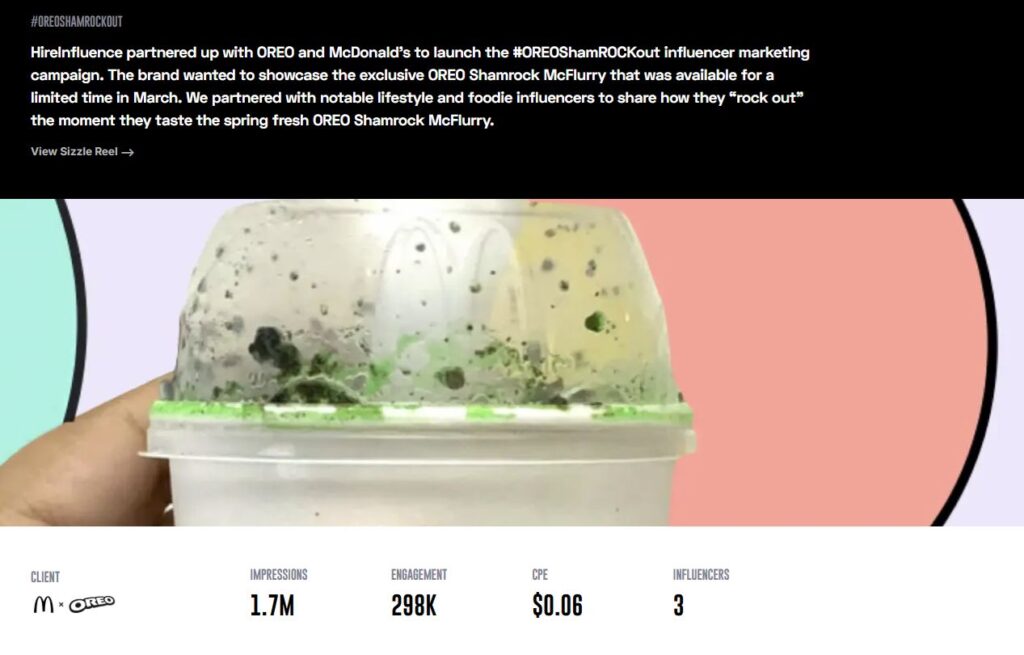
The #OREOShamROCKout programme for Oreo and McDonald’s returned 1.7M impressions at $0.06 cost per engagement across a two-brand partnership. The #SouthwestSaysAloha programme for Southwest Airlines delivered 56M impressions and 3M engagements, a scale that depends on creator content being cleared and authorised before media was placed rather than after.
Additional campaign detail is published in the work portfolio.
The HireInfluence Model for TikTok Programs
Founded in 2011, HireInfluence is a full-service influencer marketing agency built for enterprise brands, headquartered in Houston with offices in Austin, Los Angeles, and New York. The firm runs creator programs for brands including Coca-Cola, Honda, MTV, Microsoft, NFL, and Warner Bros, covering strategy, talent sourcing, branded content production, paid amplification, and performance reporting. Creator selection runs through a manual vetting and validation process rather than database filtering alone, and campaigns are scoped to each client’s objectives rather than sold as fixed packages.
Brands scoping TikTok work should read the guidance on Spark Ads as a brand amplification tool alongside the practical walkthrough of how to run a TikTok influencer campaign. Scoping conversations start through contact, and the firm’s background is set out on the about page.